





Doctor Who and the Silver Spiral
Update 10th Feb: The Darker Projects team have produced a rather excellent audio drama version of Silver Spiral that you can download here.
Read the preamble (why this story exists), and the aftermath.
Far across the universe, something big was about to happen. The explosion would outshine an entire galaxy and be visible billions of kilometres away. Its light would travel across the universe for millions of years but, aside from a few astronomers, it would go unnoticed on the Earth.
With a grating, wheezing noise, a small blue box flickered into existence.
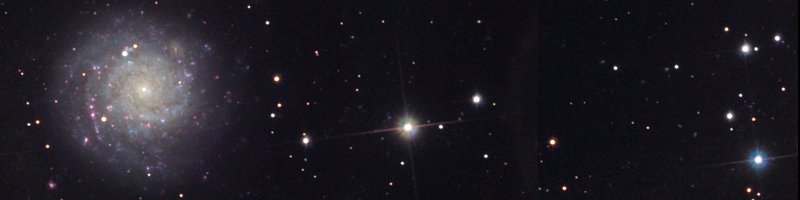
NGC1058 - a spiral galaxy in Perseus and the host of SN 2007gr CREDIT: Bob Ferguson and Richard Desruisseau/Adam Block/NOAO/AURA/NSF
"So, where are we?"
"Have a look..." the Doctor replied, tapping a control, "but... don't step outside."
The door of the TARDIS clicked open, and Martha gave him a quizzical look. "Why, what's out there?"
"Take a look" he said, a lopsided grin on his face.
Gingerly, she pulled open the door of the police box and looked out.
"Oh my God," exclaimed Martha. "Is that real?" She was looking out at a vast star-scape, hundreds of stars embedded in swirling clouds of gas, stretching out as far as she could see.
"What? Of course it's real!" he laughed, looking out over her shoulder.
"It's amazing! Where are we?"
"A long time ago, in a galaxy far, far away..." he quoted thoughtfully.
"What?"
"Sorry. We're in a galaxy the local species call the 'Silver Spiral'. From Earth, it's a tiny, faint speck in the sky, somewhere in the constellation of Perseus. You'd never even notice it without a telescope. These stars are part of a cluster formed just a few million years ago, out in one of the spiral arms."
"It's beautiful. But... why are we here?"
"Why not?" he said. "Have you ever seen a star explode?!"
She stared at him.
"You see that one?" he said, pointing to a large red star to one side of the cluster. "It's just one ordinary star doing what it does but, any minute now, for a tiny fraction of time, it will become brighter than this entire galaxy! The explosion will be visible in the skies of thousands of species across hundreds of galaxies. To most of them it's just another transient star, but not you humans, oh no! Scientists on your planet point as many telescopes as they can at it. They even give it a name: 2007gr."
She grimaced.
"No, not very poetic really," he admitted. "Logical though - because they discover it in 2007. You lot, all you've got to understand the universe are the photons you collect, those tiny little pathetic scraps of energy that travel on through the universe until they hit something. And yet you know so much! That's what I love about you humans, always curious, always trying to understand, study and catalogue the universe, and, even when you don't know all the facts, always blundering on..."
"You can talk!" retorted Martha.
"Yeah... gets me into trouble," he said with a grin that stretched from ear to ear, "but that's half the fun!"
"So it's a star that's actually going to explode?"
"Yep!" he paused. "Well, technically, there's a collapse first, then an explosion."
"Oh." She looked worried. "Hang on, aren't we a bit close? Shouldn't we, well, move out of the way?"
"Nah! We'll be fine."
"But it's made of wood!"
"Trust me, she's tougher than she looks."
Pressing buttons, shifting levers and twisting knobs, the Doctor danced around the console. You'd never guess he was 900 years old, she thought, he acts more like an excitable five year old half the time.
"Doctor," she asked, looking out at the star through the open door, "why does it collapse?"
"Hmm?" he said distractedly. "Oh, it runs out of fuel."
"Like an engine?"
"More like a nuclear fusion reactor. The temperature and pressure in the core of a star are so high that hydrogen nuclei fuse together forming helium, that's what creates all that heat and light that keeps Earth from freezing."
"The Sun is a giant fusion reactor?" asked Martha in disbelief.
"Oh yeah, the Sun has been fusing hydrogen for, oooo, five billion years by your time."
"Wow. So when a star runs out of hydrogen.... what, it stops?"
"Then," he said excitedly, "it starts to shrink. The temperature and pressure go up as it collapses until it's hot and dense enough that the helium nuclei start to undergo fusion."
"The helium that was made from fusing the hydrogen?"
"Right. And when it runs out of helium to fuse..."
"It shrinks and gets hotter, right?"
He nodded. "It shrinks, gets hotter, and starts fusing the helium forming carbon, nitrogen, oxygen - the stuff that makes up most of you. Just think, you're made from chemicals that were created in the heart of a star." He grinned at her again.
She looked down at her own hands curiously. "All right, say I believe you, you still haven't explained why it explodes!"
"Ah, well, eventually if a star is heavy enough, that burning process carries on through heavier and heavier elements, going faster and faster until it gets all the way to iron. Once you get to iron, you need a lot of extra energy to keep the fusion going, and there's no where for it to come from. The core starts to collapse again, but uncontrollably this time..."
"Pulled by gravity?"
He nodded again. "... until it reaches the density of nuclear matter, effectively becoming one giant atomic nucleus, but then there's nowhere for it to go but back out the way it came, and KABOOM!" he yelled, causing Martha to jump in surprise, "the material in the core rebounds and causes a shock wave which rips through the star, stopping the inward fall of material and causing an explosion."
"So does every star do that? Oh my God, is that going to happen to the Sun?"
"No," he laughed. "The Sun's not nearly heavy enough. It is quite common though, pretty much every star more than about eight times the mass of the Sun will end its life this way."
"So why is this one so special?" Martha asked, puzzled.
"Aha, wait and see!"
"Look, there, it's about to go! An explosion with the energy of ten octillion megatons of TNT, such a violent comparison..." he paused, with a curious expression on his face. "Ah! I've got it, it's the same energy released in one second as a star like your Sun releases in 30 *billion* years!" he said triumphantly.
"How long?" Martha exclaimed.
"Oh, except the Sun isn't going to last that long. It turns into a red giant in, ooo, about the year five billion. Then it expands and swallows the Earth. I should know, I was there."
Martha gaped at him.
"Oh yeah." He paused, "I met the Face of Boe that day."
"Oh my God, you're serious!"
"Always", he grinned again.
"Any moment now, wait for it.... *there!* And look, there, do you see those jets of material? They're moving at about one hundred and fifty thousand kilometres every second, that's about half the speed of light!"
Martha stared at the spectacle in front of her. Where, a moment ago, there had been a fairly ordinary-looking large red star, there was now such a bright light that it hurt to look at it. Peering down she saw a jet of material shooting away from the site of the explosion. She tried to make out what was in it, but it was just a blur.
"But," she said, turning back to the interior of the TARDIS, "isn't light the fastest thing in the universe?"
"That's right, nothing travels faster, the ultimate speed limit! You need a lot of energy to travel that fast, and there isn't enough energy even in a supernova to do that. This stuff is pretty quick though, and this is the first time astronomers on the Earth have seen an outflow like that happen."
"Hang on," said Martha. "You said astronomers on earth called this explosion 2007gr because they saw it in 2007? But light takes time to travel anywhere, and the Earth must be miles away...."
"Thirty five million light years, or thereabouts." replied the Doctor.
She looked puzzled. "And a light year is...?"
"The distance light travels in an Earth year. One light year is about, oh, nine and a half thousand billion kilometres."
"So does that mean we're way in the past? Are there dinosaurs running around on Earth right now?" Martha asked excitedly.
"Not likely, they mostly got wiped out sixty five million years before your time. That was quite a day," he muttered. "No, thirty five million years ago mammals were running around on land and there were even sharks starting to appear in the oceans." He leaned on the console and looked at Martha. "Now, there's an idea, how would you like to see prehistoric Earth?" He pushed a couple of buttons on the console, then looked up quickly, his eyes sparkling, focussed behind Martha, looking out the open doors. "I've always wanted to try this..." he said quietly.
"Try what?" asked Martha suspiciously.
"This! Here it comes, hang on to something!"
A second later, the shockwave hit. Tossed about like a leaf in a hurricane, the TARDIS bounced around, riding the shock front like an insane surfer. Martha grabbed the edge of the console and clung on for dear life. She looked across at the Doctor, but he didn't look worried. Quite the opposite in fact. He had that expression of childlike excitement and wonder on his face. "Woooo hoooooo!" he yelled. "Now that's the way to travel!"
"You," she exclaimed, "are *completely* mad!"
"Oh yes!" he grinned back as the shock passed by.
The TARDIS slowly righted itself and once more dematerialised.
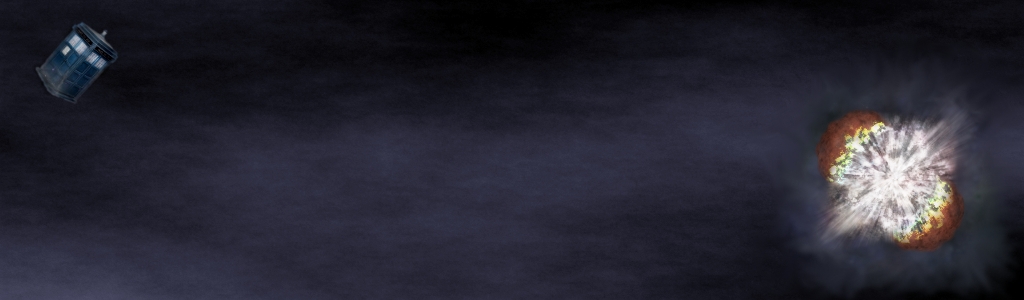
The TARDIS watches a supernova explosion CREDIT: SN: NASA/CXC/M.Weiss; TARDIS: BBC; composition: Megan
 What you have just read is a fictional story. Supernova 2007gr was real, however, and the event described is based on the paper "A mildly relativistic radio jet from the normal Type Ic Supernova 2007gr" by Paragi et al, published in Nature on January 28th 2010. Read the press release from JIVE. You can also hear an audio versionof the story I narrated for a laugh.
Thanks to everyone who read and commented on early drafts, especially PS and JB!
Doctor Who and the TARDIS are trademarks of the BBC.
Paragi, Z., Taylor, G., Kouveliotou, C., Granot, J., Ramirez-Ruiz, E., Bietenholz, M., van der Horst, A., Pidopryhora, Y., van Langevelde, H., Garrett, M., Szomoru, A., Argo, M., Bourke, S., & Paczyński, B. (2010). A mildly relativistic radio jet from the otherwise normal type Ic supernova 2007gr Nature, 463 (7280), 516-518 DOI: 10.1038/nature08713
Crockett, R., Maund, J., Smartt, S., Mattila, S., Pastorello, A., Smoker, J., Stephens, A., Fynbo, J., Eldridge, J., Danziger, I., & Benn, C. (2008). The Birth Place of the Type Ic Supernova 2007gr The Astrophysical Journal, 672 (2) DOI: 10.1086/527299
Soderberg, A., Chakraborti, S., Pignata, G., Chevalier, R., Chandra, P., Ray, A., Wieringa, M., Copete, A., Chaplin, V., Connaughton, V., Barthelmy, S., Bietenholz, M., Chugai, N., Stritzinger, M., Hamuy, M., Fransson, C., Fox, O., Levesque, E., Grindlay, J., Challis, P., Foley, R., Kirshner, R., Milne, P., & Torres, M. (2010). A relativistic type Ibc supernova without a detected γ-ray burst Nature, 463 (7280), 513-515 DOI: 10.1038/nature08714
Posted by Megan on Wednesday 27th Jan 2010 (18:21 UTC) | 57 Comments | Permalink