







In the news this month... shaping the heliosphere
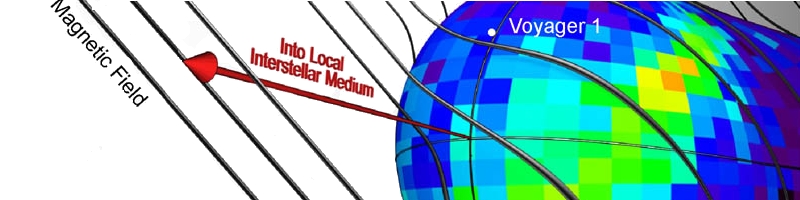
IBEXs view of the heliosphere CREDIT: Adler Planetarium/Southwest Research Institute
Solar physicists thought they knew the shape of the Sun's heliosphere, but new results from the Interstellar Boundary Explorer have revealed a huge ribbon of intense emission that was completely unexpected. The space between stars is not empty, but filled with a very tenuous gas known as the interstellar medium. As the Sun moves through this gas it emits a fast moving plasma know as the solar wind. These charged particles spread out spherically creating the heliosphere, a cavity in the interstellar medium swept out by the solar wind.
Launched in October 2008, the Interstellar Boundary Explorer, IBEX, was designed to investigate the nature of the interactions between this solar wind and the interstellar medium at the edge of the solar system where the wind hits the ISM and slows down in a termination shock at what is known as the interstellar boundary. This boundary region emits no light so it cannot be detected by conventional telescopes. Models predicted that the shape of the heliosphere resembled a comet, a sphere that was swept back by the Sun's movement through the ISM, but what IBEX found was something different.
IBEX was designed to detect particles known as energetic neutral atoms. These start off as ionised atoms in the boundary region where they can pick up electrons and become neutral. Ionsed atoms have electrical charge and are affected by the charged plasma of the solar wind and the magnetic fields that are carried with it. Once they become neutral they are no longer affected by these magnetic fields and travel along straight trajectories. The detectors on IBEX were designed to pick up these energetic neutral atoms coming from the boundary region and over six months of observations, they mapped the whole sky.
What the results show is an unexpectedly bright ribbon of emission running almost 360 degrees around the sky, a feature that was not predicted by models of the heliosphere. This ribbon is thought to be where charged particles are becoming bunched at the boundary. The reason for this is not certain, although David McComas, IBEX's principle investigator, suggests that it could be caused by the magnetic fields of the Milky Way's own galactic wind interacting with the heliosphere.
The results, published in the journal Science during October, put the observations of the Voyager spacecraft in context. The two Voyager probes were launched in 1977 and are currently traveling through the interstellar boundary region where the energetic neutral atoms originate. While the results from IBEX match what the Voyager probes are encountering, the bright strip discovered by IBEX runs right between the positions of the two spacecraft. Eric Christian, IBEX deputy mission scientist at NASA's Goddard Spaceflight Centre likens this effect to having two weather stations which miss a big storm passing directly between them. The ribbon has also been detected in data from the Cassini spacecraft, although at different energies to the particles detected by IBEX. While it seems clear that the true shape of the heliosphere is somewhere between a comet and a perfect sphere, much more modeling is needed.
McComas, D., Allegrini, F., Bochsler, P., Bzowski, M., Christian, E., Crew, G., DeMajistre, R., Fahr, H., Fichtner, H., Frisch, P., Funsten, H., Fuselier, S., Gloeckler, G., Gruntman, M., Heerikhuisen, J., Izmodenov, V., Janzen, P., Knappenberger, P., Krimigis, S., Kucharek, H., Lee, M., Livadiotis, G., Livi, S., MacDowall, R., Mitchell, D., Mobius, E., Moore, T., Pogorelov, N., Reisenfeld, D., Roelof, E., Saul, L., Schwadron, N., Valek, P., Vanderspek, R., Wurz, P., & Zank, G. (2009). Global Observations of the Interstellar Interaction from the Interstellar Boundary Explorer (IBEX) Science DOI: 10.1126/science.1180906
Funsten, H., Allegrini, F., Crew, G., DeMajistre, R., Frisch, P., Fuselier, S., Gruntman, M., Janzen, P., McComas, D., Mobius, E., Randol, B., Reisenfeld, D., Roelof, E., & Schwadron, N. (2009). Structures and Spectral Variations of the Outer Heliosphere in IBEX Energetic Neutral Atom Maps Science DOI: 10.1126/science.1180927
Mobius, E., Bochsler, P., Bzowski, M., Crew, G., Funsten, H., Fuselier, S., Ghielmetti, A., Heirtzler, D., Izmodenov, V., Kubiak, M., Kucharek, H., Lee, M., Leonard, T., McComas, D., Petersen, L., Saul, L., Scheer, J., Schwadron, N., Witte, M., & Wurz, P. (2009). Direct Observations of Interstellar H, He, and O by the Interstellar Boundary Explorer Science DOI: 10.1126/science.1180971
Fuselier, S., Allegrini, F., Funsten, H., Ghielmetti, A., Heirtzler, D., Kucharek, H., Lennartsson, O., McComas, D., Mobius, E., Moore, T., Petrinec, S., Saul, L., Scheer, J., Schwadron, N., & Wurz, P. (2009). Width and Variation of the ENA Flux Ribbon Observed by the Interstellar Boundary Explorer Science DOI: 10.1126/science.1180981
Schwadron, N., Bzowski, M., Crew, G., Gruntman, M., Fahr, H., Fichtner, H., Frisch, P., Funsten, H., Fuselier, S., Heerikhuisen, J., Izmodenov, V., Kucharek, H., Lee, M., Livadiotis, G., McComas, D., Moebius, E., Moore, T., Mukherjee, J., Pogorelov, N., Prested, C., Reisenfeld, D., Roelof, E., & Zank, G. (2009). Comparison of Interstellar Boundary Explorer Observations with 3-D Global Heliospheric Models Science DOI: 10.1126/science.1180986
Krimigis, S., Mitchell, D., Roelof, E., Hsieh, K., & McComas, D. (2009). Imaging the Interaction of the Heliosphere with the Interstellar Medium from Saturn with Cassini Science DOI: 10.1126/science.1181079
Posted by Megan on Saturday 31st Oct 2009 (08:51 UTC) | Add a comment | Permalink
Comments: