







Eta Carinae

The location of η Carinae, click to enlarge CREDIT: Megan / Ephem
Eta (η) Carinae is a very massive star that is easily visible from the Southern hemisphere, the image on the left shows the star's location. It is fairly near the end of it's life, is very unstable and may go supernova fairly soon (in astronomical terms that is, it may be many thousands of years before it actually happens). The star sits inside a huge nebula, known as the keyhole, and appears to have two enourmous bulges coming from it. These are caused by a strong wind from the surface of the star which carry significant amounts of matter into the surrounding space. More massive stars tend to have stronger winds, and η Carinae is pretty large so it's wind is very strong. The wind streams out from the surface of the star and is collimated by a disk of material around the star which forces the material in two directions producing the bipolar structure (the bulges) seen in Hubble images.
Because it is the nearest example of such a massive star, astronomers have kept a close watch on it for many years. Some features seen in previous observations of η Carinae suggested that it had a companion star, but no direct evidence for one has ever been seen. One piece of evidence leading to this conclusion was the variation seen in x-ray emission on timescales of 5.5 years. This could be explained by a smaller companion star with a 5.5 year orbit. The winds from each star will collide at some point between the two stars and it is this region which generates the high-energy x-ray emission. As the stars orbit each other, η Carinae eclipses this region of emission as seen from Earth.
Searches have been made for emission from the companion star before, but it has never directly been observed. Now, astronomers using the Far UV Spectroscopic Explorer (FUSE)satellite have observed the system and found more evidence for the companion star. They observed that the high energy UV light dimmed two days before the last x-ray eclipse, this UV light is too energetic to be emitted by η Carinae itself as it is a relatively cool star so it must have come from the companion star, which really is pretty impressive. The stars are too close together to be directly resolved by our current telescopes, so this is the best evidence yet for the existence of this second star. NASA have a press release about this which is worth reading.
If you live in the Southern hemisphere, have a look at this object, it's quite impressive, even through binoculars. The photo below shows the Pointers (two bright stars on the left), Crux (middle) and η Carinae (red blob on right). It was a three minute exposure taken from Siding Springs with a Pentax K2 on a static tripod back in 2003.
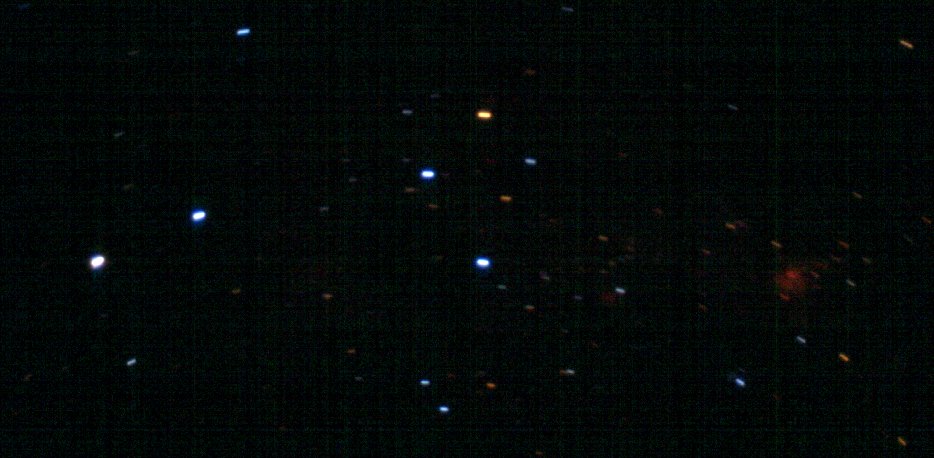
The Pointers, Crux and Eta Carinae from Siding Springs CREDIT:Megan
Why is the nebula red? I'll tell you later...
Comments: